


Author:
MA Nataliia Shapovalova — actress, director, and acting teacher. As a senior lecturer at the Kharkiv National Kotlyarevsky University of Arts, she teaches puppetry acting and explores the possibilities of working with objects and various materials. Alongside her academic work, she continues to develop her directing practice and is a co-founder of the VECHORIA theatre and youth studio.
Contemporary puppetry theatre constantly offers new forms, explorations, and experiments. Artists turn to reinterpreting classical themes by discovering personal experience within them; the theatrical performance becomes an expression of the artist, with their own “language” of existence, in which the actor personifies their inner “self” in relation to the animated object they bring to life. But who is this actor of modern puppetry theatre, and what professional qualities should they possess?
A persistent problem within the theatre community, particularly in the post-Soviet space, is the continued training of actors within a framework of performance psychology that confines them to functioning organically only within the director’s concept. As a result, there is a notable lack of distinctive actor-artists—those who, rather than shifting into directing to realize their ideas and creative vision, are able to communicate their personal experience both as authors and as performers. I personally encountered this issue while working in a state theatre after completing my studies, and only later was I able to understand the reasons for my rejection of the existing system. In my view, this problem calls for a modern rethinking of pedagogical methods in actor training, along with the introduction of new practices that prioritize revealing the student’s individuality and contribute to shaping a versatile, fully developed actor capable of finding their own creative path of self-expression.
For this reason, within the educational process of the Department of Acting and Directing in Puppetry at the Kharkiv National University of Arts named after I. P. Kotlyarevsky, a form of work called the “monologue with a puppet” was introduced, which we successfully implemented in two acting courses.
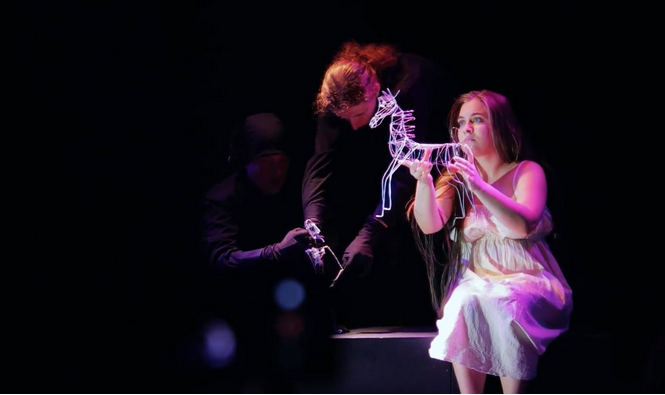
The aim of the “Monologue with a Puppet” stage is to refine professional skills through the creation of a character from classical drama using the means of puppetry theatre. Its specificity lies in the fact that this stage responds to the demands of contemporary times and processes present in the field of modern art, while still being grounded in the fundamental principles of professional training for a puppetry actor.
Creating a monologue with a puppet based on classical drama makes it possible to uncover the contemporary relevance of a work, filter it through one’s own worldview, and realize an individual vision of well-known literary archetypes by experimenting with form and various expressive tools of puppetry theatre.
Moreover, this form of work allows the student to broaden their knowledge, artistic taste, acting range, and emotional spectrum, as well as to demonstrate their imagination and figurative thinking. The “monologue with a puppet” format integrates multiple tasks and involves a significant amount of independent work, in which the teacher’s primary role is to guide the students’ exploration and experimentation.
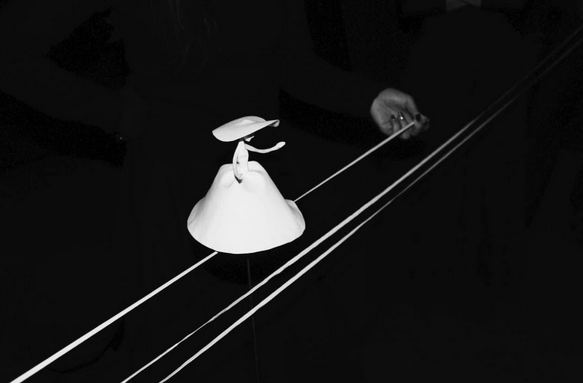
But why a monologue, when contemporary drama largely rejects it, considering this form of narration too improbable and overly theatrical? In contrast to dramatic theatre, where the monologue often adds to a sense of staticity, in puppetry theatre it becomes compelling precisely because the immersion into the essence of the character’s inner world allows for the clear creation of the protagonist’s universe in visual forms. Within this space, the narrative acquires symbolic meaning, making it possible to find an appropriate mode of the actor’s presence on stage, to construct partnership, and to develop a relationship with the puppet.
The monologue as a form is also significant because it condenses the character’s experiences, allowing one to present their views, beliefs, attitudes toward a given situation or problem, as well as their character traits. It places the figure in an active position and in an intensified emotional state at the moment of speech, while maintaining structural integrity and compositional completeness. Moreover, must one focus exclusively on classical drama, or even solely on drama? Of course not—this space also allows for experimentation. However, the text should guide the creation of a clear stage image and enable its realization through the means of puppetry theatre.
Work on a monologue with a puppet requires a coherent and systematic approach; therefore, for the effective organization of the educational process, eight main stages were proposed, through which the student passes on the way to creating the monologue:
– searching for texts;
– theoretical stage;
– work with the author’s text;
– development of the visual concept;
– production of animated objects;
– stage realization of the monologue with a puppet;
– work on shaping the artistic image;
– work on atmosphere and the integrity of the stage expression.
As aptly noted during a conference discussion by Marek Waszkiel, this methodology begins exclusively with drama, which serves as the starting point for further stage embodiment. This is also connected with the tradition of theatre schools in the post-Soviet space, where drama has tended to dominate over form. This does not mean that students learn to work exclusively in this way, but in the early years of study such an approach helps to structure thought and clarify the idea the author intends to express.
As a result, the student must create a complete artistic image with the puppet, demonstrating an understanding of the “super-objective,” mastery of puppetry techniques, control of tempo and rhythm, a clear embodiment of the role’s core, and a vivid emotional range. The student learns to combine deep textual analysis with practical work using the puppet, to build a perspective on the role, and to find visual means that fully reveal the idea and theme of the work. This stage enables the development and refinement of professional skills of a puppetry actor and lays the foundation for their further professional application.
If we speak about the search for the “new puppet” within this method, it is worth noting that this form of work particularly supports such exploration, as it does not limit the possibilities of the animated object. Rather, it depends on the student’s courage and imagination to enter unknown territory and move beyond the expressive means of the classical puppet.
It should also be noted that the “monologue with a puppet” can exist not only as a stage in the educational process, but also as a segment of a theatrical performance. As a result of this work, two performances emerged from the created monologues: Cranberry Juice and Brothers and Sisters. Within the stage space, texts of world classics were brought to life—Shakespeare, Brecht, Goldoni, Goethe, Euripides, Chekhov, Ostrovsky, Gogol, and others.
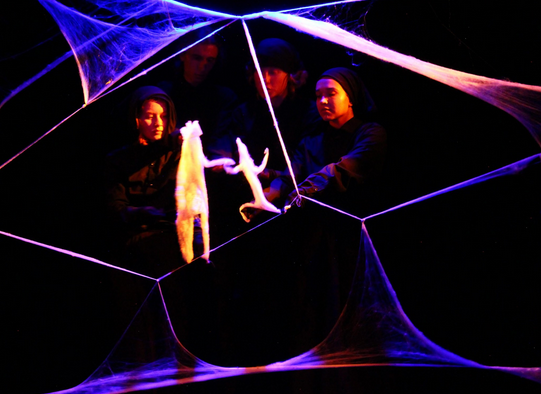
An example of an interesting visual solution, as well as a harmonious integration of literary material and expressive means, is an etude based on William Shakespeare’s Macbeth. Its foundation was Lady Macbeth’s monologue, in which she provokes her husband to murder King Duncan. The character of Lady Macbeth was merged with the figure of the witch, thus revealing the true nature of her intentions. The students proposed a material resembling a spider’s web, which became the basis for the entire stage space. Puppets woven from webs emphasized both the timelessness of the theme and the fragility of human life. The web symbolized the intrigue woven by the characters for their own benefit—an intrigue in which they themselves ultimately become entangled.
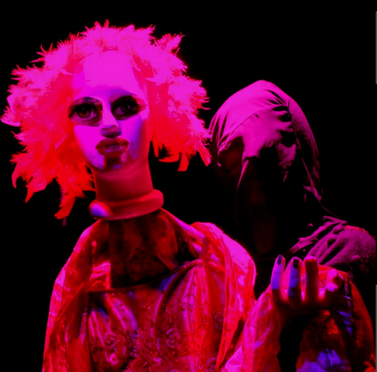
Another example is Nina Zarechnaya’s monologue from Anton Chekhov’s play The Seagull, in which she speaks about her tragic experiences and her dream of becoming a famous actress. Cut-outs from magazines, feathers, and a mannequin create an impression of artificiality and superficiality, emphasizing the character’s egoistic focus solely on herself and her own needs. The monologue acquires an entirely new tonality and, although it is delivered with pronounced pathos, the traditional драматизм usually inherent in it is completely lost—Nina appears helpless in her ambitious desire to become a renowned actress, and her sincere convictions sound entirely false.
An example of a search for synthetic means of expression is Agafya Tikhonovna’s monologue from Nikolai Gogol’s play Marriage. In this fragment, the main heroine, telling fortunes with cards against the backdrop of night, cannot decide which of her suitors is more worthy of her attention. However, because she selects only her favorite physical traits, the characters are depicted with exaggerated ears, mouths, and eyes. The monologue embodies a fantasy of a frightening dream, in which the suitors pursuing the heroine attempt to catch her and draw her into their own webs.
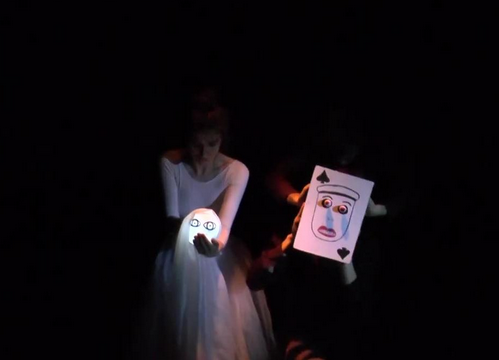
The performances were warmly received by audiences in Kharkiv and were also successfully presented at the 9th International Festival of Puppetry Schools in 2018 in Białystok (Poland) and at the 1st International Multigenre Festival “STRUS” in Lviv (Ukraine).
The introduction and exploration of new methods within the educational process of a higher theatre school should respond to the demands of contemporary cultural processes, while remaining grounded in the traditions of systematic training. It is crucial to find a balance between providing space for the student’s creative experimentation and personal expression, and focusing on mastering acting techniques and training, which we strive to integrate in the work on the “monologue with a puppet.” This stage sets the direction for further development, offering an impulse toward a holistic approach in training puppetry actors, refining methods of revealing the author’s creative position, and understanding the importance of personal expression. The educational process should become a space for shaping the actor as an artist, and the “monologue with a puppet” stage can serve as a first step that enables the student to express themselves.
Of course, in the context of discovering and implementing multimedia technologies in puppetry theatre and researching animatronic puppets, the “monologue with a puppet” method may not appear particularly modern, as is also reflected in the conference program. However, in my view, in the pursuit of purely new forms, the methodology of training a new actor/director—and ultimately the theatre itself—may lose depth in the search for meaning and content, as well as a systematic approach to creating the stage image and the role. To avoid this, experimentation and the search for one’s own artistic language must be firmly grounded in fundamental principles, both theoretical and practical.
The challenge for the teacher lies in finding a balance—either in integrating contemporary trends in theatre development into the curriculum, or in opening up to the demands of the present. Therefore, such dialogue between representatives of different cultural backgrounds, generations, theatrical spheres, and professional experiences—as demonstrated by the conference—is essential, as it opens new perspectives on contemporary puppetry, its problems, and its needs.
For this reason, I would like to conclude that the future of the “new puppet,” in my opinion, lies in multiculturality, multidisciplinarity, and multigenre approaches—possibilities that can emerge only through dialogue: between artist and artist, between artist and object, and between artist and audience.
