


Author:
MA Natalia Sakowicz — actress, puppeteer, and lecturer at the Aleksander Zelwerowicz National Academy of Dramatic Art in Warsaw – Branch in Białystok. She creates her own theatre productions, including “Pobudka”, “Oddaleńcy”, and “Romans”. She received the award for outstanding expression through puppetry for “Pobudka” at the International Festival of Puppet and Animation Theatre for Adults “A Puppet Is Also Human”, an award for Pobudka at the International Puppet Theatre Festival “Visiting Arlekin” in Omsk, and an acting award at the WTEA International Theatre Festival in Beijing.
She has also received scholarships from the President of the City of Białystok, the Marshal of the Podlaskie Voivodeship, and the Polish Ministry of Culture and National Heritage through the “Young Poland” programme.
The words “mindfulness” and “tenderness” have recently been declined through every possible grammatical case. Ever since Olga Tokarczuk delivered her Nobel lecture about the tender narrator — one who notices others and remains sensitive to their voice and needs — the word “tenderness” has become especially popular in certain circles. New books and theatre productions are constantly emerging, all devoted to a tender approach toward others and toward oneself. The slogan of “tenderness” has become so fashionable that I would hardly be surprised if it were soon invited as a special guest on television talk shows, answering the host’s questions about how it feels about its fame and whether it has taken on too much responsibility. Sitting beside “tenderness” on the couch of such a fictional TV programme, perhaps called Word Trends, would be another guest — or rather, a female guest — “mindfulness.” It is interesting that both terms are feminine in grammatical gender. What a parallel — both emerge from the world of women and seem deeply woven from feminine energy.
When I began writing this article, I did not intend to address feminist themes, though they are close to me and to my artistic explorations. And yet, I cannot escape them. Everything I am currently engaged with is interconnected: feminism – tenderness – mindfulness. What do these last two concepts mean, and how do they relate to Lalka Nova and to puppetry in general? I will try to explain this and briefly describe my work with the puppet during rehearsals for the performance Romans, a process I tentatively called “the method of mindfulness and tender touch.”
Mindfulness means being here and now. It means engaging one’s whole self — thoughts, spirit, and body — in the present moment. It is the ability to notice everything happening around us and within us, exactly in the place and time in which we exist. By analogy, being unmindful means a complete or partial lack of awareness of oneself and one’s surroundings. It may mean that the body is physically present in a specific place and time, while the mind escapes either into the past or into what has yet to happen. Most often, this is exactly how we function. We do not have time to stop and truly notice the world around us, to contemplate it and experience it. Usually we think about all the things we still need to accomplish and what will happen if we fail to do them. We behave as if we were competing for the title of the busiest person of the year or the champion of multitasking. Another extensive study could be written in an attempt to answer why we do this to ourselves, but I will leave that question to psychologists and sociologists.
What interests me is the cost we pay for thinking and acting this way, and how it influences the quality of our lives and our work. The result is, of course, living in a state of permanent stress and other negative emotions which, when left unexpressed, accumulate in the body and create muscular tension. At first we do not notice this or we ignore the initial somatic symptoms, but eventually the body itself demands attention and speaks in the form of pain.
I remember that at the beginning of 2020 everyone was struggling with heightened stress caused by the pandemic and searching for ways to cope with it. Some people baked sourdough bread, others became enthusiastic home gardeners cultivating houseplants, while still others turned to sports or other activities such as yoga and meditation. I belonged to the latter group. I have practised yoga on and off for several years and have noticed its positive effects, such as increased flexibility and improved concentration, but I only began practising meditation recently. Searching for a way to calm my thoughts and release tension in my body, I became interested in mindfulness practices. These involve a secular form of meditation during which one observes thoughts, emotions, and bodily sensations arising in the present moment. This method has long been used in hospitals when working with patients, but increasingly it is also being introduced in schools and corporations as an effective way of coping with stress. One of the fundamental assumptions of the method is training oneself to become an internal observer who notices everything happening in the body and mind at a given moment. Exercises drawn directly from this technique — or merely inspired by it — help calm the mind and, above all, ground a person in the present moment. Similar effects can also be achieved through other practices, such as movement exercises aimed at developing bodily awareness, yoga, or Eastern martial arts. One may choose a single activity and specialise in it or — as I do — experiment with various techniques. In my own practice, I draw from selected exercises originating in several methods, modify them slightly, and incorporate them into actor training.
Contemporary actors face the same difficulties as the rest of society. They must cope with an overwhelming number of stimuli and information impossible to process in a short amount of time, all while living at a dizzying pace and under pressure to succeed in every area of life. They often work full-time in theatres, simultaneously create independent productions, take additional jobs in radio or television, and, like everyone else, struggle with countless private matters and domestic responsibilities. Carrying this entire burden of problems and expectations, it is difficult, upon crossing the threshold of the theatre, to suddenly become fully present and attentive on stage as if by magic — and yet this is precisely what directors, scene partners, and audiences expect from actors.
A distracted and overstimulated actor is often absent — they look at their partner but seem not to see them; they speak to them but do not truly communicate. An actor who has lost real contact with their body and senses also loses connection with their partner and with the audience. This negatively affects the quality of performance. The objective of the acting task becomes blurred, falsehood appears. The actor begins to imitate, externally performing emotions and states they supposedly experience, and as a result loses what is often called “stage truth.” That is why the actor’s full presence on stage is so fundamentally important.
What, then, should one do in order not to drift mentally toward matters unrelated to art and instead remain fully here and now within the acting task? Should one think more intensely about the moment, open one’s eyes wider, strain one’s hearing more sharply? To be truly mindful, one must have something anchored in a specific place and time — something we can always return to and hold onto in order to remain “here and now.” That something is our body. It is real, undeniable, and genuinely present in a given place and moment. One must remain in constant contact with one’s body and senses. Various forms of physical exercise that develop bodily awareness and increase sensitivity to external stimuli can be extremely helpful in this regard. Through systematic training, we keep both body and mind fully present and ready for action.
When working on mindfulness, it is best to begin with exercises performed individually in order to focus exclusively on one’s own body and mind. Then, without losing the effects already achieved, one may move on to working with a partner. One should exist and act with them according to the same principles practised alone: observing them attentively, listening to them, and touching them with awareness. A similar approach may also be applied to working with inanimate matter: space, objects, or props. For me, as an actress-puppeteer — and especially as a solo puppeteer — the puppet is my principal stage partner. It is with the puppet that I build events, enter into dialogue, and upon which my attention must remain fully concentrated.
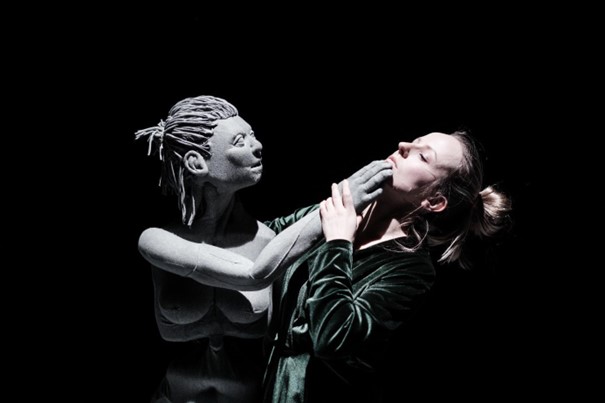
What has always seemed most fascinating to me in theatre of form is the relationship created between the actor and the puppet. Of course, not every theatrical subject allows for such a bond to emerge. Sometimes one simply has to perform something using a form, treating it more as an object. But that is not enough for me. I think of the puppet as an equal stage character. I do not want merely to use it — I want it to gain subjectivity and tell the story in its own voice.
I have never been particularly concerned with the precision of animation. More than a perfect imitation of life, I am interested in what I create through contact with the puppet. Sometimes I construct a relationship in which I stand above the puppet, giving and taking away its life. The puppet, both literally and metaphorically, is then in my hands, and it is I who decide for it — about its movement or stillness. At other times I create the opposite arrangement: I humbly serve the puppet, and it becomes the most important and the strongest presence. In practice, I still manipulate the form, but now with an entirely different intention — I listen to it, remain attentive to it, and carefully execute even the smallest gesture. Sometimes, however, I surrender control to the puppet. Then it becomes the animator, while I carry out its commands. I do not even need to pretend its agency — it genuinely exists, for example when I work with the puppet’s weight.
I used this strategy of movement in my previous solo performance, Pobudka. The piece told the story of a contemporary girl encountering the most famous female characters from the Grimm fairy tales. One of them was Sleeping Beauty — a life-sized puppet whom the protagonist, played by myself, tried to awaken throughout the performance. Near the end of the piece there is a scene of our dreamlike dance resembling a psychedelic waltz, during which I surrender to Sleeping Beauty’s lead. Her body, naturally collapsing under the force of gravity, directs our hypnotic dance. It is the puppet’s weight — not I, the animator — that generates the impulse for movement.
I employ a similar principle in one moment of Romans. After an operatic sequence, I consciously drain movement from the puppet, position it upright, and wait for the moment when its centre of gravity shifts. The puppet then falls, and I attempt to catch it at the very last second. I must remain extremely alert, noticing in time the direction in which the puppet is collapsing and reacting quickly by offering my own body as support. I deeply appreciate these kinds of moments in working with form — moments when I allow the form to dominate while I myself retreat into the background.
Most often, however, I place an equal sign between myself and the puppet. I try to build a partnership with it, one in which both of us possess an equally important voice. We then enter into dialogue, listen to one another, and learn from each other. There is something intriguing at the intersection of these two bodies: the living and the dead. The mere coexistence of life, embodied by the actor, and death, symbolised by the motionless puppet, creates tension. One does not even need to move the puppet for its image alone to carry meaning. Of course, one may also manipulate the form, set it into motion, and thereby give it life. Yet in my way of thinking and in the working method described in this article, I share life with the puppet rather than simply giving it life. I transfer part of myself to the puppet by shifting my attention onto the animated form. I imagine the puppet’s body as an extension of my own, and its sensory experiences as also belonging to me. Through touch we influence one another. At the point where our bodies connect, all kinds of information are exchanged.
It is similar to the relationship between dance partners. Through the frame or through guiding a hand, one dancer transmits the impulse for movement to the other, giving it rhythm and direction. I am deeply fascinated by this space — a kind of database, a transformer of information. Observing, investigating, and physically sensing this connection constitutes a large part of my work with form in Romans.
Several factors shaped my method of working with the puppet: the content of the performance, my acting, pedagogical, and puppetry skills. Yet the greatest influence on my practice came from dance experience — or more broadly, from working with the body. Before becoming an actress, I trained professionally in ballroom dance for many years, a form based on dancing in pairs according to a precise and highly codified technique. During my years as a dancer, and later as an actress and lecturer, I participated in numerous movement workshops. I explored the basics of ballet, contemporary dance, yoga, butoh, and even boxing.
Most recently I took part in a several-month-long cycle of movement research sessions titled Searching and Creating at the Studio Oddaj Ciężar in Warsaw. There I worked with other performers under the guidance of several choreographers and representatives of contemporary dance. Together we observed how our bodies moved and how the quality of movement changed depending on various conditions. We worked individually, but also in pairs and small groups. The themes we explored included the search for pleasure in movement, the relationships between different parts of the body such as the spine and limbs, body weight, softness, and elasticity.
These research sessions coincided with rehearsals for Romans, and some exercises from the workshops I transferred directly into my work with the puppet. I wanted to investigate how experiences gained from working with my own body and with the body of a dance partner could be translated into work with form — which tasks could be performed with inanimate matter and which could not, and what kind of results they might produce. During rehearsals for Romans, I also collaborated with dancer and choreographer Iza Szostak. Together we tested different movement strategies useful for building scenes in the performance and worked on conscious touch. We realised that the way I touch the form has enormous significance for the meanings communicated on stage. The way I hold the puppet — with force or with tenderness — speaks about my attitude toward it.
This approach to the form was essential in constructing Romans, which tells the story of a relationship between two female characters: an addiction/demon/toxic lover played by me, and the victim represented by the puppet. The scenography is highly minimalist: a rectangle made of grey dance floor and a dozen glasses filled with water. Apart from these elements, the stage remains empty. There is no doubt what matters most in this story — the puppet and my relationship with it.
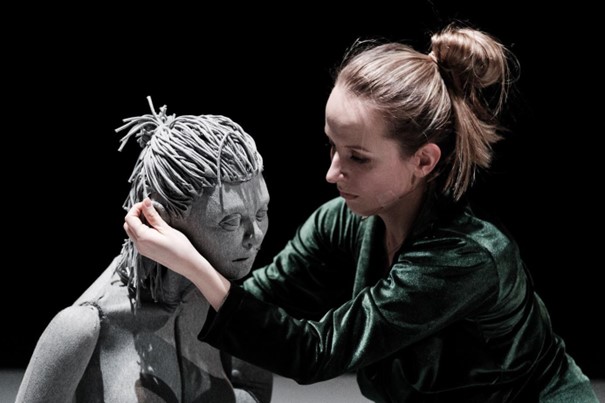
The puppet, created by Olga Ryl-Krystianowska, is life-sized, equal to my own height, with an almost anatomical structure complete with defined muscles and breasts. Every part of it — from the toes and eyeballs to the hair on its head — is covered in the same grey cotton fabric. The puppet’s construction is made from foam, which makes its body soft, pliable, and relatively lightweight. All of its joints, including the fingers, are movable. Even the puppet’s jaw is mobile, allowing me to imitate the movement of its lips. The puppet’s name is Marta.
Rehearsals for Romans, as well as warm-ups before performances, usually begin with solo exercises focused on concentration and sensitising my own body. I begin with a relaxing and attention-focusing meditation during which I observe my breath. I lie down or sit comfortably on the floor. I close my eyes and redirect all my attention inward, into my body. I observe my breathing. I try to breathe only through my nose, calmly and steadily, guiding the inhale into the abdomen. I use pranayama exercises — breathing control techniques practised in yoga — or simply count the duration of inhalations and exhalations, gradually lengthening both sequences so that the breath slows down. I focus on breathing for several minutes. At the same time, I observe the thoughts and emotions accompanying me. I look at them from a distance, without identifying with them or attaching too much importance to them, allowing thoughts to flow in and out. Throughout, I continue breathing calmly.
Then I move on to “scanning” my body. From the perspective of an inner observer, I examine my body to determine whether I feel tension or discomfort in any areas. If I find such a place, I imagine directing my breath toward it. With each exhalation, the tension gradually releases and the body becomes softer. Slowly I move the “scanner” from my head through the entire body, trying not to overlook anything, until I reach my feet.
Next, I explore my contact with the floor. I notice which parts of my body touch the ground and which remain slightly lifted. I try to feel the weight of my body fully surrendered to the surface beneath me. Again, with each exhalation, I imagine my body becoming softer and heavier, melting downward into the floor. Gradually I introduce small movements initiated from a chosen point of contact between my body and the ground, as if massaging my body through pressure against the surface. Following the principle of seeking pleasure, I make circular and sliding movements like an animal rubbing itself against a tree trunk or a stone. Remaining within this slow action, I search for places in the body that need massage and, moving very slowly and without losing contact with the floor, I change positions. I lie down, sit up, roll — everything slowly and fluidly. I avoid sudden transitions, moving carefully into each new position while continually focusing my attention on the contact between my body and the ground.
I massage large muscles, bones, and other obvious surfaces, but I also try to reach less accessible places such as the crown of the head, the armpit, the collarbone, or the arch of the foot. Throughout the exercise I remain aware of my breath and the weight of my body. When I feel ready, I slowly open my eyes without interrupting the previous action. I observe how my bodily sensation changes when the sense of sight joins in. I try truly to see what I am looking at. A useful practice is naming aloud whatever one notices in the moment: ceiling, door, handle, window, and so on.
At this stage it is very easy to lose one of the tasks — to allow the gaze to become absent or to forget about surrendering weight to the floor. One must constantly shift awareness between the visual field and the point of bodily contact being massaged, back and forth again. It is difficult to maintain complete attention on several senses simultaneously — to see attentively, touch consciously, and also hear or feel at exactly the same moment. Such a state becomes possible only through long-term practice, and only then can we truly speak of full presence. Until that point is reached, one must continually redirect attention from one point in the body to another.
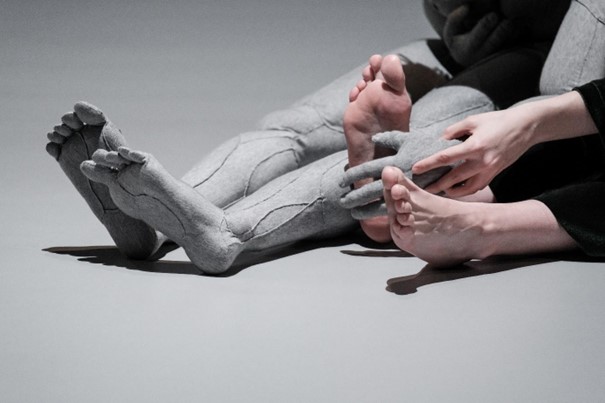
After this kind of warm-up, I move on to an exercise in tender touch. I sit comfortably. I keep my eyes open — I may look at what I am doing or focus my gaze elsewhere. I may also shift my gaze during the exercise and observe what changes, and whether my sensations differ. I maintain the quality of mindfulness developed during the warm-up.
I now focus on one hand, either the right or the left. I gently touch the other fingers with my thumb, close my hand, open it, move my fingers simultaneously or each one separately. I register the temperature of my hand and the softness of the skin. Then I place my hand on another chosen part of my body. It may be my other hand, or my cheek or neck. I choose to touch an uncovered place, where clothing does not cover the skin. I place my slightly tense hand so that it rests on the border between touch and non-touch. At this moment, I feel the delicate hairs growing on my skin beneath my fingers. I move my hand across my body and register these subtle sensations.
Then I decide to relax my hands so that they fall freely onto the chosen part of the body. I feel the softness and temperature of the skin. My hand, wandering across the body, registers the shapes it encounters, changes in roughness, or possible birthmarks. At a certain point, I stop the movement and direct my attention deeper, trying to feel what lies beneath the surface of the skin. The movement of my hand remains fluid; I do not change it abruptly. I now use slightly more force, pressing and kneading the chosen part of the body because I want to feel its muscles, tendons, and bones.
At some point, I calm the action. I simply place my hand on the body and no longer move it. I imagine that my touch passes through the tissues into the depths of the body. I think about the warmth of my hand travelling all the way inside the part being touched. Then I imagine that I am not touching with my hand, but with its muscles or skeleton. Finally, placing my hand on my cheek, I ask myself whether it is my hand touching my cheek, or my cheek touching my hand. I explore each of these possibilities and play with different images.
I transfer exactly the same tasks into my work with the puppet. I sit in such a way that my centre of gravity is as close to the form as possible, and slowly extend my hand toward it. With attentiveness, I wait for the moment when our two bodies meet. When the pads of my fingers feel the presence of the fabric covering the puppet, I gently lift them away. I want to find the place at the edge of touch. I feel the delicate nap of cotton beneath my skin. I keep my hand tense so as not to cross beyond the smallest possible touch. My awareness then travels to a few tiny points on my fingertips, where, sometimes for only a fraction of a second, I feel the outer layer of the material.
My hands almost levitate above the puppet, and yet they are so close that they keep touching it. They are positioned exactly in such a way that it is no longer I who consciously decide to touch; rather, touch happens almost by itself, through tiny tremors in my body. The next step is to touch the puppet again, this time by slowly laying down my whole hands — first one, and after a while the other. After touching the puppet’s outer layer, I relax my entire arms so that their weight calmly settles onto the form. It is a very soft movement. I feel the fabric — its temperature and thickness — with my whole hands.
I move them gently across the puppet’s body and explore its shape: all its recesses and bulges. Some parts of the form are smooth and long, and then suddenly I encounter an unexpected fragment full of small details. I change the ways of touching: sometimes I simply place my hands on it, at other times I move them across the puppet’s body, brush against it, or stroke it. I do not want anything to escape my attention. There is, of course, a certain degree of improvisation in this action. I follow whatever interests me at a given moment. Sometimes I focus on a detail, at other times on larger surfaces.
Sometimes I shift my attention to sight and check whether it is present here and now, whether I notice what my eyes rest upon. It is very easy to sink inward and become so focused on the sensations in the hands that one forgets to observe actively. I want to remain aware both of what is outside me and of the sensations within my body.
While in contact with the puppet, I check who is touching whom. I play with the image that it is I who am being touched by the puppet, and then again that it is the other way around. With each breath, I deepen my contact with the form. With each exhalation, my touch moves into the depth of the puppet, and I imagine touching its centre, its construction, or its empty spaces. I wonder what shape and texture the puppet has from within. Then I imagine that my hand passes all the way through the puppet and that I am touching the surface on which it lies or sits.
The next stage is to place my hand inside the puppet, around its face. Through the opening in its back, I slowly introduce my hand, registering everything I encounter along the way. When my hand reaches Marta’s eyes, I imagine that my sensitive fingers pass through the puppet’s structure and look. I try to see the image that my fingertips see and wonder how similar it is to the one I see myself. It differs slightly, because it is seen from another angle, a dozen or several dozen centimetres away. I look at myself through the puppet and once again imagine how she — or my fingers inside her — sees me.
I transfer my mindfulness, as in the earlier solo exercise, from one specific point in my body to another point in either my body or the puppet’s body. At one moment, awareness is in my gaze; at another, in the puppet’s gaze; then in my hand holding the puppet; and next in the puppet, which notices this. I constantly play with shifting my attention, sharing it with Marta and remaining in a tender relationship with her.
How does my practice fit within the idea of Lalka Nova? The exercises involving body awareness, meditation, or mindfulness techniques are, of course, nothing new. Yoga and meditation are as old as the world itself, while mindfulness practices emerged around forty years ago. Likewise, body training and conscious work with movement and breath are not new in actor training. The greatest masters of acting — from Jerzy Grotowski to the recently very popular among Polish actors Uta Hagen — emphasized the importance of regular physical practice in maintaining performers’ psychophysical readiness. As actors, we need to return once again to these practices in order to pause amid the rush, focus our attention, catch our breath, and truly experience what is happening here and now.
What does feel new to me is the transfer of experiences drawn from body-awareness exercises and meditation directly into work with form. Through mindfulness practice, including meditations inspired by mindfulness techniques, I train my stage presence. Thanks to them, I remain in full contact with both my body and the puppet. I rarely become distracted. I notice an improvement in my concentration on the acting task. During rehearsals or performances, my thoughts no longer drift toward matters unrelated to the piece being performed. This gives me a sense of calm while on stage, one that sometimes surprises even me. I feel relaxed yet active. I know that my thoughts, emotions, and body are all prepared to act and receive stimuli here and now.
The method of mindfulness and tender touch described above had a direct influence on my performance in another sense as well: some scenes are built, to a greater or lesser extent, precisely upon the approach outlined here. Certain moments in the performance are constructed around the strategy of tender touch, while others are based on mindfulness and the constant shifting of attention between the puppet and myself. The first, relatively long scene of the performance is a kind of meditation with the puppet. During this sequence, which presents the growing familiarity between the two protagonists of the drama, I explore the puppet, examine its anatomy and movement, and it responds in kind. The scene is tender, delicate, and subtle. It speaks about the emergence of an intimate relationship between the characters and stands in complete opposition to the final scenes of the performance, when my approach toward the form becomes entirely different. Then I treat it objectively, coldly, and without emotion. I even use violence toward it.
This opposition forms the dramaturgy of the entire performance: from pleasure and fascination to collapse and disintegration. Such, after all, is the dynamic of addiction and every other toxic relationship.
I am aware that the approach I propose will not work in every theatre-of-form production. Not all performances are concerned with the actor-puppet relationship. Nevertheless, it is worth experimenting with these exercises, at least during rehearsals and especially during the first encounters with a puppet. Every form, like every musical instrument, possesses its own unique characteristics that must be discovered and understood. Meditating with a puppet can also be helpful shortly before a performance. Spending several or even a dozen minutes in contact with one’s own body and the puppet’s body can calm thoughts, reduce stress, quiet the mind, and redirect attention toward the form with which one is about to perform.
Ultimately, the method I propose is a pleasurable practice, as well as an excellent exercise for developing bodily awareness and imagination — qualities which, in my opinion, are the most important attributes of a good puppeteer-actor.
