

Author:
Marek Bieganowski, MA – visual artist and constructor of puppets and scenographic forms, affiliated since 2023 with the AST National Academy of Theatre Arts Krakow (Wrocław branch). Head of the visual arts studio, where he creates scenographic elements and puppets.
Introduction
The Sicilian marionette, rooted in the tradition of Opera dei pupi, constitutes one of the most fascinating phenomena in European theatrical culture. At first glance, it may be perceived as an element of folklore or a form of popular entertainment; in reality, however, it reveals a far more complex character. It is simultaneously a material object, a performative tool, and a carrier of narrative deeply embedded in epic tradition.
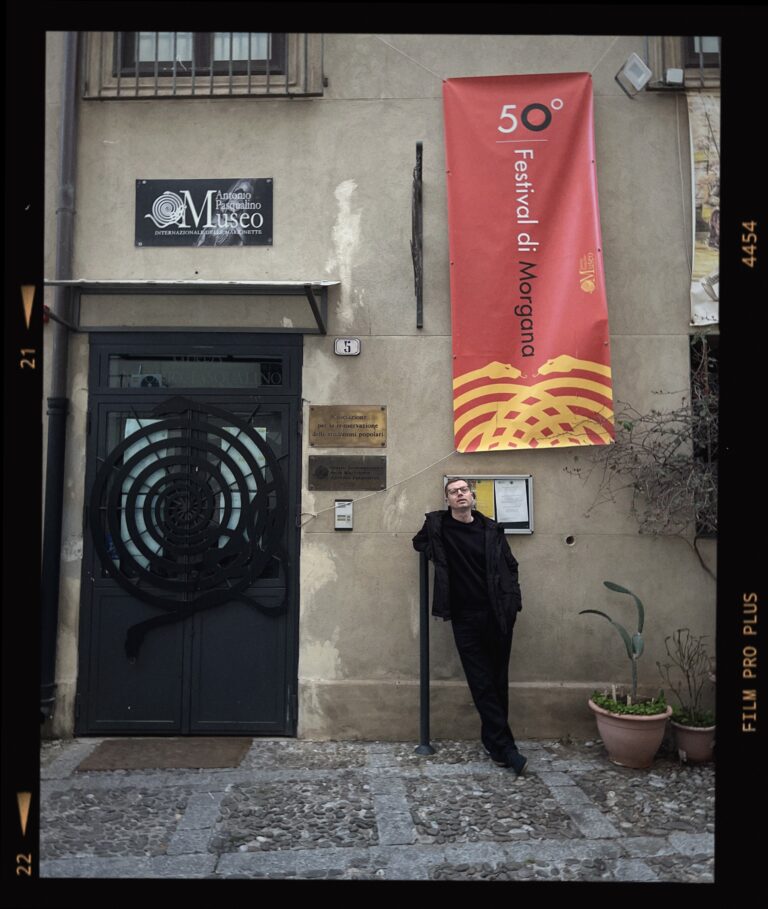
This text was written in connection with a visit to the International Puppet Museum Palermo (Erasmus+) and attempts to examine the Sicilian marionette not merely as a component of performance, but as an autonomous cultural object—one whose form, function, and meaning emerge at the intersection of craftsmanship, narrative, and social practice.
The Marionette as a Material Object
One of the defining features of Sicilian marionettes is their pronounced materiality. Unlike the lightweight string puppets known from other European traditions, pupi are heavy, solidly constructed figures, often equipped with metal armor and wooden bodies.
Their construction is not accidental. The weight—sometimes reaching several dozen kilograms—directly influences both the method of manipulation and the aesthetics of movement. The marionettes move more slowly and decisively, lending scenes of combat a particular intensity and gravity. Matter—wood and metal—not only builds the physical presence of the object but co-creates the theatrical language.
It is also important that these marionettes are produced within a workshop-based, often family-oriented practice. Their creation involves visual artists, costume makers, and puppeteers. As a result, the marionette is not an individual work but the outcome of collective labor and intergenerational transmission.
Narrative as the Source of Form
The form of the Sicilian marionette is inseparably linked to its repertoire, which primarily consists of stories about knights and the struggle between good and evil. These narratives, developed in a serial manner, required the creation of characters that were immediately recognizable to the audience.
A strong relationship can be observed between visual features and narrative roles. Each character possesses a set of identifying signs:
Orlando is recognizable by the eagle on his helmet and his distinctive eyes,
Rinaldo stands out through his red costume and the symbol of a lion,
Angelica is depicted as a figure of beauty and refinement,
Gano di Maganza bears features of betrayal and moral ambiguity.
This system allows the audience to identify a character instantly, even before the dramatic action begins. The marionette thus functions as part of a visual code in which form and meaning remain closely intertwined.
Stylization Instead of Realism
A key aspect of the aesthetics of Sicilian marionettes is the conscious departure from realism. Costumes and armor, although inspired by history, do not reproduce it faithfully. Instead, they are stylized to achieve maximum visual clarity.
A good example is the physical deformation of certain figures, such as Orlando’s characteristic eyes. This should not be interpreted as a flaw in execution. On the contrary, it is a deliberate device that enhances expressiveness and visibility for the audience.
In this sense, the marionette does not represent reality but interprets it. Its purpose is not to recreate the world faithfully but to construct a form that is readable and evocative within theatrical conditions.
Stage Function and Object Construction
The construction of the marionette is strictly subordinated to its stage function. In performances of Opera dei pupi, scenes of combat, duels, and dramatic reversals play a central role. Therefore, the marionettes must be capable of executing specific actions: dynamic clashes, falls, simulations of death (decapitation, splitting the body, etc.), and interactions with scenographic elements.
The form of the object is thus the result of a compromise between durability and functionality. Each structural element serves a defined dramaturgical purpose.
From the perspective of a contemporary puppet maker, there is nothing particularly innovative in the construction of Opera dei pupi puppets. What is striking, however, is how simple means achieve striking trick effects, despite the apparent heaviness of the construction. For example, the decapitation of a character is triggered by a strong pull of the control rod. Many of these solutions remain relevant, especially the subordination of form to stage action and the relationship between the object’s weight and its expressive movement.
Theatre as a Space of Social Experience
Puppet theatre in Sicily fulfilled a function that extended far beyond entertainment. It was a space of shared experience, where spectators not only watched performances but actively lived through them.
Historical accounts indicate a strong identification of audiences with the characters. The story of a spectator unable to sleep, worried about the fate of the imprisoned Orlando, illustrates the depth of this engagement. Marionettes thus functioned as real emotional entities.
Community and Communication
Performances did not end with the fall of the curtain. They became starting points for conversations, discussions, and interpretations.
Spectators analyzed the actions of the characters, evaluated their decisions, and related them to their own experiences. In this way, puppet theatre became a medium of social communication and a tool for building community.
Transformation and Contemporary Context
With the development of new media, the function of puppet theatre has changed. It has not been replaced so much as it has ceased to respond to the needs of contemporary audiences.
Today, Opera dei pupi functions primarily as cultural heritage and a performative tradition, often linked to tourism. In 2001, Opera dei pupi was inscribed on the UNESCO Intangible Cultural Heritage list. At the same time, it remains an important testimony to a former way of narrating the world.
Conclusion
The Sicilian marionette is an object that resists simple classification. It is neither merely a theatrical prop nor solely a craft object. It constitutes a point of intersection between multiple domains: material, narrative, and social.
Its form results from the function it fulfills in performance, from the stories it conveys, and from the tradition in which it is created. The analysis of this object reveals that matter is not a passive background for human action but an active participant in the creation of meaning.
Sicilian marionettes remind us that stories require form, and form requires matter. It is precisely in their encounter that theatre is born.