


Autorzy:
dr Mateusz Barta – actor, puppeter, lecturer at National Academy of Theatre Arts – branch in Wroclaw (Puppetry Faculty), a member of Young Scientists Council.
Where did the idea for Finland come from?
Turku had been present in my awareness for quite some time—mainly due to conversations with Professor Anna Twardowska. In the 2000s, as Vice-Rector of the Wrocław branch, she maintained regular contacts with the local puppetry department there. It was one of those directions that exist in the background—without a concrete plan, but within a clear context.
Before Puppet Net was created, I was looking for a tool that would allow me to organize and connect the dispersed activities of contemporary puppet theatre artists. It was not about a one-off project, but about a lasting platform for exchange.
During this search, I came across the Impulse Project website. It was one of the first initiatives that presented international collaboration among puppeteers in a more structured way. Among its co-creators was Aura of Puppets from Turku, alongside groups from other European countries.
At that stage, it was purely observational—browsing materials, checking who was working and how, and what models of collaboration already existed. I did not assume then that these same places would later become reference points for Puppet Net.
Only over time, as the project began to take a more concrete shape, it became clear that a natural next step would be study visits to places where similar solutions were already in operation. This is how the route gradually crystallized, encompassing centers in Turku, Lisbon, and Vilnius—places that had previously existed for me mainly as examples, but over time became real partners.
On the plane from Gdańsk to Turku in the first days of December, most passengers were parents with children. They were continuing further north to visit Santa Claus Village.
After landing, it quickly became clear that the overcast weather was not an exception, but the norm. Low light, no sun, damp air—a typical beginning of winter in this part of Finland. The bus ride to the city center offers a glimpse into everyday life at this time of year. The same motif repeats in apartment windows: illuminated stars or electric candle holders placed on windowsills. The decorations are simple, yet present almost everywhere. They are part of the landscape, not just a holiday ornament.
In the café beneath the hotel, I bought classic Finnish cinnamon buns and headed toward the Aura River. A ferry operating for most of the day connects the two banks of the city and functions as an ordinary means of transport, not a tourist attraction.
The headquarters of Aura of Puppets is located within a complex of buildings designated for cultural activity. It is a group of pavilions housing various independent entities— theatres, artistic collectives, studios. It is not a single institution, but a shared workspace where different organizations operate side by side.
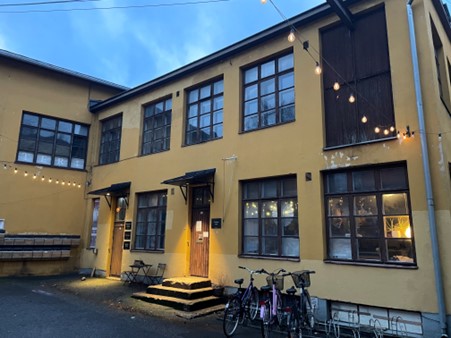
What is it like?
You step inside almost as if entering someone’s home. There’s no reception, no clear division between the “audience area” and the “company space.” A corridor leads directly into a shared area—a table, a kitchenette, a few workstations. Posters from previous productions hang on the walls; in one corner, elements of stage design are stacked. This is not a single theatre, but a backstage for several groups operating simultaneously. Each of them works according to its own principles, yet they all use the same infrastructure. The model of sharing space and resources feels natural here—not as a formal project, but as an everyday practice. During the day, the place functions partly as a workshop, partly as a production office. Someone sits at a computer answering emails, while someone else tests stage solutions.
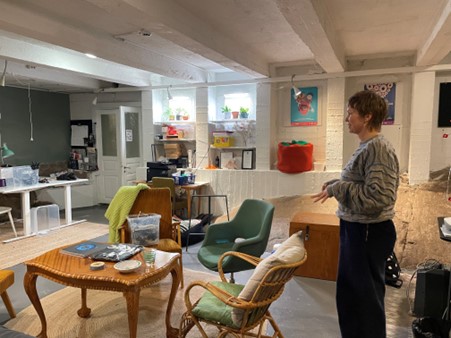
Conversations quickly turn to organizational matters: funding, project mobility, international collaborations. It becomes clear that artistic activity here is closely tied to the ability to navigate grant systems and partnership networks. This is not the support structure of an institution—it is an independent ecosystem that has to sustain itself.
Equally important is its placement within a broader complex—several similar entities operate side by side, in the same or neighboring buildings. This creates a working environment in which contact between artists from different disciplines is constant. In the photo is Taru Tuomisto. Taru is the driving force behind Aura and the manager of the entire project. It is thanks to her that I had the chance to experience Finnish puppet theatre from the inside.
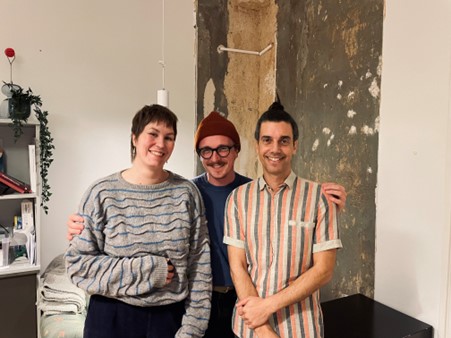
A co-creator of Aura of Puppets is Ishmael Falke—an acclaimed puppeteer known and respected across Europe. And here’s a fun fact: during the Puppetry Schools Festival organized by our Faculty—specifically in 2004—Ishmael performed his monodrama “The Golemanual.” He remembers his visit to Wrocław very fondly.
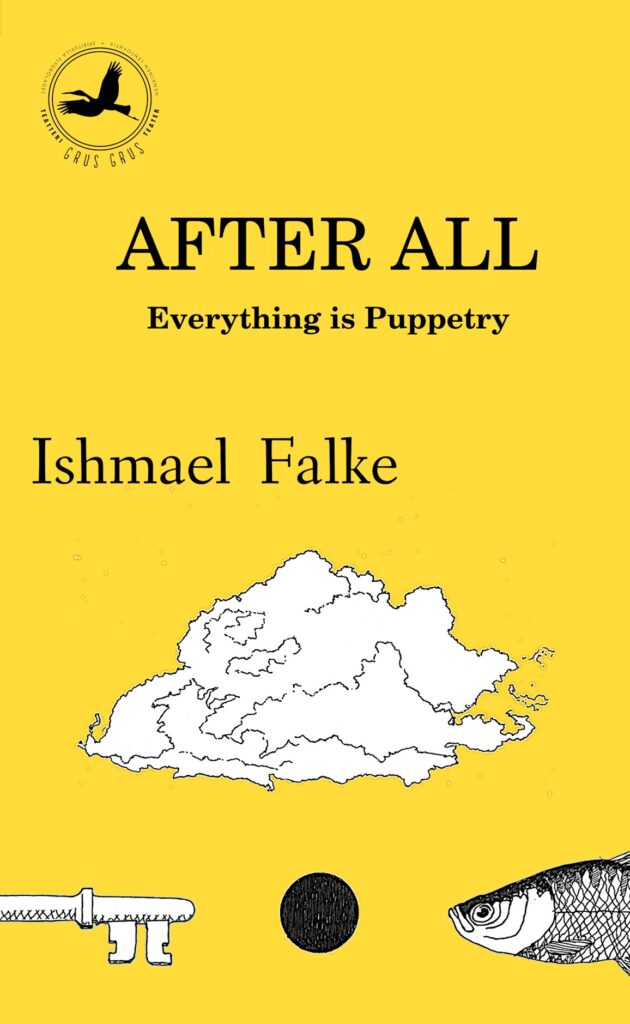
Today, Ishmael has published a book titled “After All. Everything is Puppetry,” which I hope will soon find its way into our Academy’s library.
Right after my arrival (28 November), Taru and Ishmael took me to the premiere of an installation by visual artists in a former tram depot. Aura not only produces performances, but also acts as an incubator for freelancers, offering them space to work and co-creating initiatives valuable to Turku (in this case, together with Grusgrus Theatre).
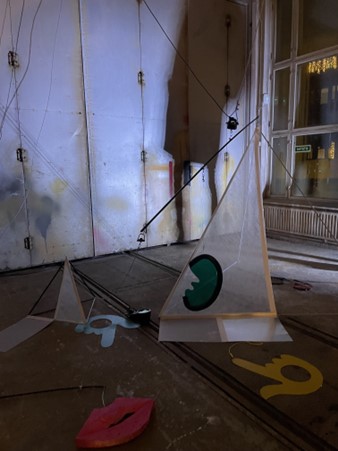
“Kineettinen keltainen” (“Kinetic Yellow”)—the color yellow in Turku used to be the iconic color of the city’s trams, associated with speed, optimism, carefree energy, and forward-thinking. Today, only buses run through Turku, and the installation becomes a kind of expression of longing. The event description reads as follows:
“At the end of November, after a long sleep, the color yellow sets out on a journey once again, as lighting designer Jarkko Forsman, scenographer and puppet theatre artist Johanna Latvala, and kinetic art artist Tuomo Vuoteenoma create a spatial artwork in the old tram hall on Amiraalistonkatu Street, brought to life through the means of kinetic art, light art, and puppet theatre.”
AURA OF PUPPETS, together with the neighboring Tehdas Teatteri, organizes the International Puppet Theatre Festival in Turku. I had the opportunity to see the final presentations of three artistic residencies that served as a prelude to the main event planned for autumn. The showings took place as part of an evening titled “Lyhäri.” The participating groups were selected through an open call, and each miniature was developed over the course of one week.
Anniina Saksa and Antti-Juhani Manninen focus on exploring sound and communication. They are interested in what human communication is and how it connects with intuition and the diversity of sonic expression. Their starting point is the phenomenon of cacophony in nature and an attempt to organize it into coherent structures. The multilayered soundscapes they create can function both as overlapping layers and as distinct, readable forms of communication.
Anniina Saksa works with electroacoustic music and voice, while Antti-Juhani Manninen operates at the intersection of performance and sound art.
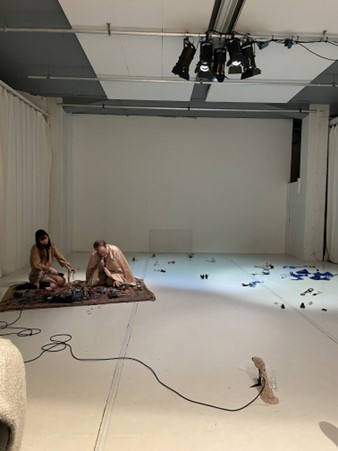
Trial & Theatre is a collective rooted in process-based creation, exploring experimental approaches to puppet theatre. The group previously created, among others, the performance “Nano Steps,” which featured the world’s smallest puppets—visible only through a microscope lens. A key point of reference in their work is the tension between the animate and the inanimate—fundamental to this form of theatre.
During the November residency, the artists focused on animation using air flow—a technique based on mechanically controlling the movement of objects or puppets through air.
Walter, a performer with Trial & Theatre, comes from the Czech Republic. He received his acting training in Prague, at one of the city’s theatre academies.
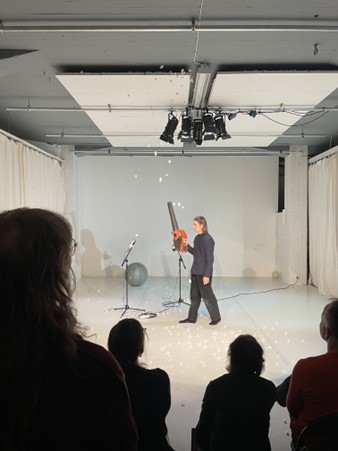
Karavan is a mobile theatre stage founded in Finland in 2020, built inside a camper trailer. The group’s latest project, Karavan Kiosk, takes the form of a performance kiosk in which the viewer can choose a show to watch.
The program consists of five short pieces, each lasting around two minutes and presented in a continuous loop for three viewers at a time. The structure of the cycle evokes the logic of content circulation in social media; however, the creators translate this logic into a space of direct, physical experience.
Karavan adapts contemporary short-form narratives into performative formats, emphasizing physical presence and the communal nature of reception. During Karavan Kiosk presentations, viewers do not use their phones.
As I write this text, it is mid-March. I somewhat regret not writing it in January—perhaps there would have been more emotional and personal “insights” and moments of fascination, because Turku truly made a strong impression on me. And just as I am trying to find a conclusion for this text, a new email appears in my inbox. Sender: Anna Ivanova, PhD.
The puppetry program in Turku (Puppet Theatre Specialization of the Performing Arts Department of the Turku Arts Academy) was closed in 2014. Since then, the community of artists connected to the program has become dispersed.
Some artists continued their work in other European countries, founding their own theatre companies or collaborating with existing institutions. Others found employment in arts education, while some chose to change their career paths.
One of the creators of this program was Anna Ivanova—a director, puppeteer, and honorary member of UNIMA in Finland—who for many years maintained close ties with the Puppetry Department in Wrocław. She is currently a lecturer in puppetry studies in Latvia. Anna’s message felt like a meaningful link and a return to the core idea of my visit to Turku. It sheds new light on future directions for international collaboration of the Puppetry Department.
P.S.
Ah—and of course, I brought back a Moomins calendar.
